
Latest data (October 16, 2026): UPI 221.48 (-1.53%) Historical performance: UPI 3M 2.62% UPI 6M 1.85% UPI 12M 29.87%

The UP World LNG Shipping Index sets the measure for the LNG shipping industry.
UPI weekly tracks the performance of publicly listed LNG shipping companies worldwide — bringing clarity to a fast-moving sector.
The UP World LNG Shipping Index (UPI) is a rules-based stock index family that tracks and measures the performance of publicly traded companies engaged in the maritime transport of liquefied natural gas (LNG).
Established in 2020, the index currently covers 21 publicly traded LNG shipping companies. This comprehensive coverage provides investors and industry professionals with a reliable tool for the LNG shipping sector.
The index uses a transparent, rules-based methodology to ensure consistent, objective tracking of sector performance. Companies are weighted by fleet capacity and market capitalisation, providing a balanced view of the industry.
UPI data is updated in real time and is accessible via our professional API, making it an essential tool for investment analysis, market research, and industry comparison.
Read more about the UPI.
The only dedicated index for the LNG shipping sector globally
A single index containing all publicly traded LNG shipping companies.
Rules-based approach ensures consistency and reliability
Latest Insights are previews from the UP World LNG Shipping Index Weekly Report — where we explain what moved the index this week, why, and what to watch next. The charts here show what the index does; the report tells you why. Full analysis on LNGshippingstocks.com.
[Subscribe to the Weekly Report →]
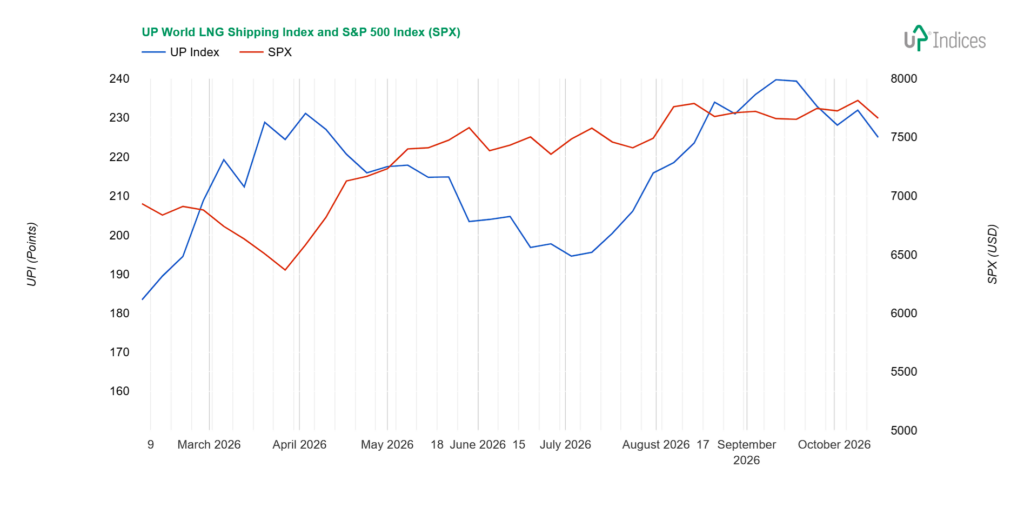
October 20, 2026: The UP World LNG Shipping Index fell 6.97 points (3.0%) to close at 224.91, pulled down by a broad equity-market selloff — the S&P 500 lost 1.95%, its biggest weekly drop since June. But the sector’s internals were far stronger than the headline: the median constituent fell just 0.43%, and the weighted index (wUPI) actually rose 2.87%, so the decline was concentrated in a few heavier names rather than reflecting genuine sector weakness. Breadth was 10:11 on above-average volume. Two Asian names led with double-digit gains — MISC +15.4% (fleet expansion with QatarEnergy and a 20-year Petronas newbuild order) and Pan Ocean +11% (breaking through all key resistance) — while the oil & gas majors surged to fresh highs: BP +8.6%, Shell +6.5% and Chevron +6.14%. The drag came from COSCO, down almost 15%, with FLEX LNG and Dynagas each off 8% and Golar −5.6%. In the background, gas markets stayed volatile and bullish: Asian prices reached $29.30/MMBtu, and European prices hit their highest since December 2022 on Hormuz tanker attacks and strong cross-basin competition, with Morgan Stanley lifting its winter TTF forecast to €90/MWh. Spot tanker rates held at $20,500 (Atlantic) and eased to $27,000 (Pacific).
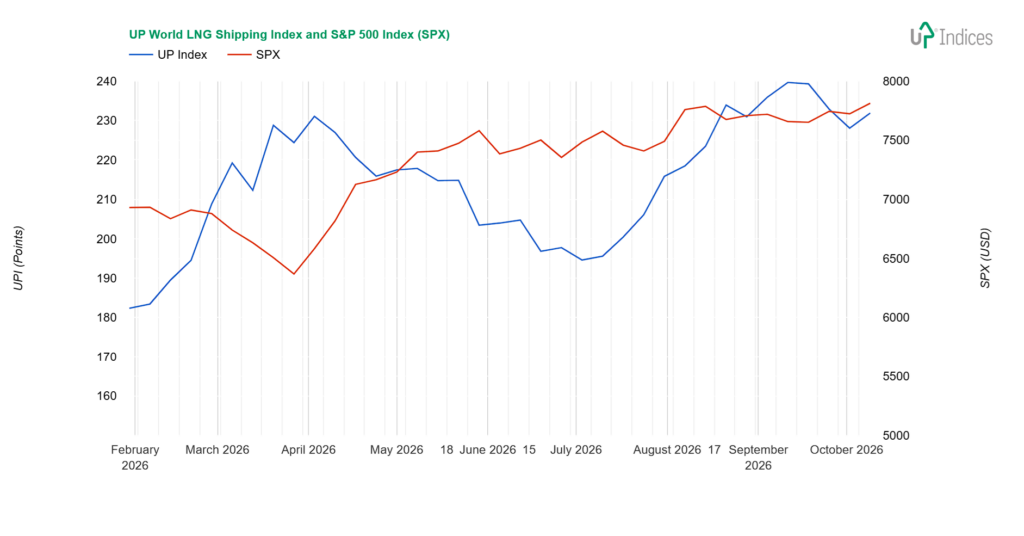
October 13, 2026: The UP World LNG Shipping Index barely moved in Week 38-2026, slipping 0.36 points (0.15%) to close at 239.27, while the S&P 500 lost 0.08%. The pause masked a split beneath the surface: decliners outnumbered gainers 8:12, and the median constituent fell 1.85%, yet the weighted index (wUPI) rose 0.6% as the heavier-weighted names — again predominantly Asian — outperformed. Trading volume ran above average. The macro backdrop was unchanged, with Asian and European gas prices firm as both regions compete for winter cargoes; European storage sits around 68.5% full, below seasonal norms, and QatarGas confirmed that the Ras Laffan refurbishment will take three years. Spot tanker rates edged up to $24,500 (Atlantic) and $26,750 (Pacific) but remain close to break-even.
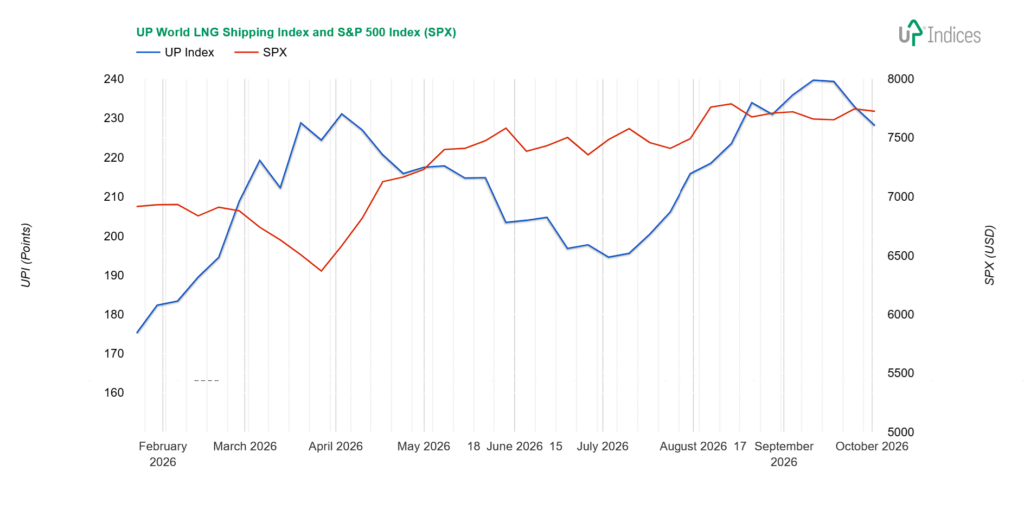
October 6, 2026: The UP World LNG Shipping Index fell for a third straight week, losing 4.84 points (2.08%) to close at 228.04. The headline tells only part of the story: breadth was almost even at 10:11, the median move was just −0.81%, and the weighted index (wUPI) actually rose by around 2% — the decline was concentrated in a few heavily weighted losers rather than across the board, and supporting indicators point to a correction within the uptrend. Volume was well below average. The two South Korean names led the gainers, with Pan Ocean surging above a long-standing resistance and Korea Line up 8.26%, while “K” Line (−5.4%), MISC (−4.08%) and COSCO (−3.93%) led the fallers, and New Fortress Energy slid to a fresh all-time-low close. In the background, the gas market kept stabilising: Asian LNG eased to around $25/MMBtu as Qatari exports crept higher, European storage entered October near 71% full, and spot tanker rates jumped to $31,500 (Atlantic) and $38,250 (Pacific).
From free insights to enterprise solutions